
Property Transaction Process in Belize
The property purchase process in Belize is influenced by its common-law system (derived from English law) and its unique national land registry. Understanding the distinction between Registered (Freehold) Land and Unregistered (M. of G.) Land is critical, as the process differs significantly. Foreign buyers have the same rights as locals to own freehold property, except for land directly on the coastline (under 66 feet from the high-tide mark), which requires a special license. All transactions should be conducted with a qualified local attorney.
Key Steps & Legal Framework:
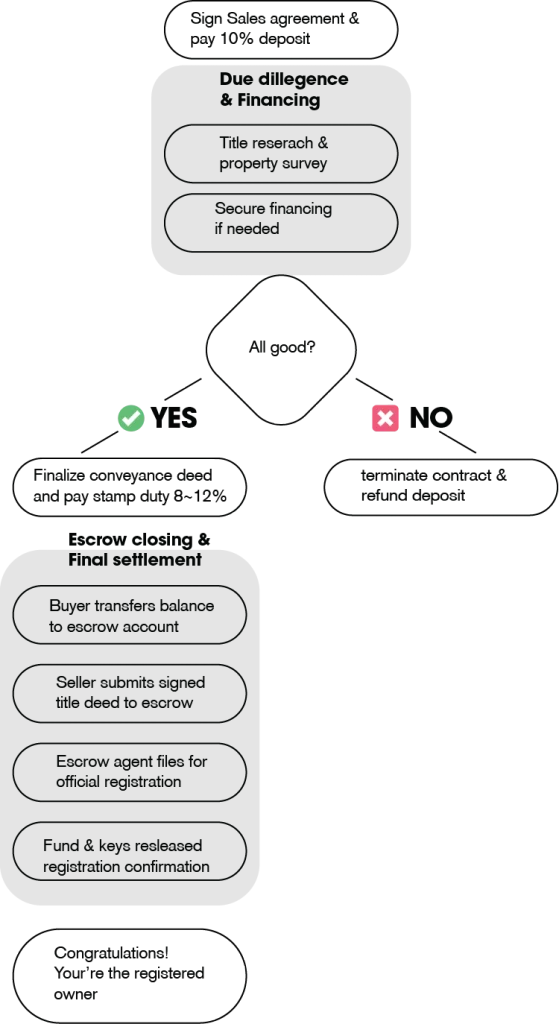
Title Verification & Due Diligence: The cornerstone of any purchase. For registered land, the attorney conducts a title search at the Lands Registry to confirm ownership, check for liens, encumbrances, or caveats. For unregistered land (conveyed via a “Memorandum of Transfer of Government Lease” or “M. of G.”), the chain of assignments must be traced, which is more complex and carries higher risk. A survey is mandatory to confirm boundaries.
Sale Agreement & Deposit:
A formal Sales Agreement is drafted by the seller’s attorney (or the buyer’s attorney in a strong buyer’s market). It outlines all terms, conditions, contingencies (e.g., financing, due diligence), and the deposit amount (typically 10%). This agreement is legally binding once signed and the deposit is paid, usually into the seller’s attorney’s trust account.
Conveyancing & Stamp Duty:
The buyer’s attorney prepares the transfer deed (Absolute Conveyance for freehold, Memorandum of Transfer for leasehold). Stamp Duty, a significant government tax (approx. 8-12% for foreigners on property value), must be calculated and paid to the Inland Revenue Department before registration. The attorney handles this payment, which is often a closing cost for the buyer.
Registration & Closing:
The stamped deed, along with application forms and proof of stamp duty payment, is submitted to the Lands Registry for official registration. Upon registration, the buyer’s name is entered as the new proprietor on the land certificate. Closing involves the final financial settlement, where the balance of the purchase price is transferred to the seller (often via an escrow or attorney’s trust account) in exchange for the keys and the registered title
The Role of Escrow:
While not mandated by law, using a licensed escrow agent is a highly recommended industry best practice for secure closings, especially for international buyers. The escrow agent acts as a neutral third party to hold all funds and documents, only releasing them when all contractual conditions are met. This protects both buyer and seller from risk during the transfer period.
STEP BY STEP
Frequently Asked Questions
Yes. Foreign buyers have the same rights as locals to own freehold property. The exception is land directly on the coastline (under 66 feet from the high-tide mark), which requires a special license.
Yes. All transactions should be conducted with a qualified local attorney, who handles the title search, prepares the transfer deed and pays the stamp duty on your behalf.
For registered (freehold) land, the attorney conducts a title search at the Lands Registry to confirm ownership and check for liens, encumbrances or caveats. For unregistered land, conveyed via a “Memorandum of Transfer of Government Lease” (M. of G.), the chain of assignments must be traced, which is more complex and carries higher risk. A survey is mandatory to confirm boundaries.
The deposit is typically 10%, usually paid into the seller’s attorney’s trust account. The Sales Agreement is legally binding once it is signed and the deposit is paid.
Stamp duty is approximately 8–12% of the property value for foreigners. It must be paid to the Inland Revenue Department before registration and is often a closing cost for the buyer.
Escrow is not mandated by law, but using a licensed escrow agent is a highly recommended best practice, especially for international buyers. The escrow agent holds all funds and documents as a neutral third party and only releases them when all contractual conditions are met.